From health trends to cosmetic procedures, few body parts have captured the cultural spotlight quite like the butt. It’s been praised, debated, sculpted, and hashtagged into mainstream conversation — yet for all the attention, Americans still have plenty of questions about what’s going on back there. Whether it’s curiosity about health, appearance, or sex, our collective fascination with butts says a lot about how we view our bodies.
To find out what’s really on people’s minds (and in their search bars), we combined Google Trends data with a nationwide survey. The study reveals the top butt-related questions each state is Googling, how confident Americans feel about their behinds, and what’s fueling those feelings — from social media influence to sex ed gaps. Together, the results show just how much curiosity, culture, and confidence intersect when it comes to one of America’s most talked-about body parts.
States With the Most & Least Butt Confidence
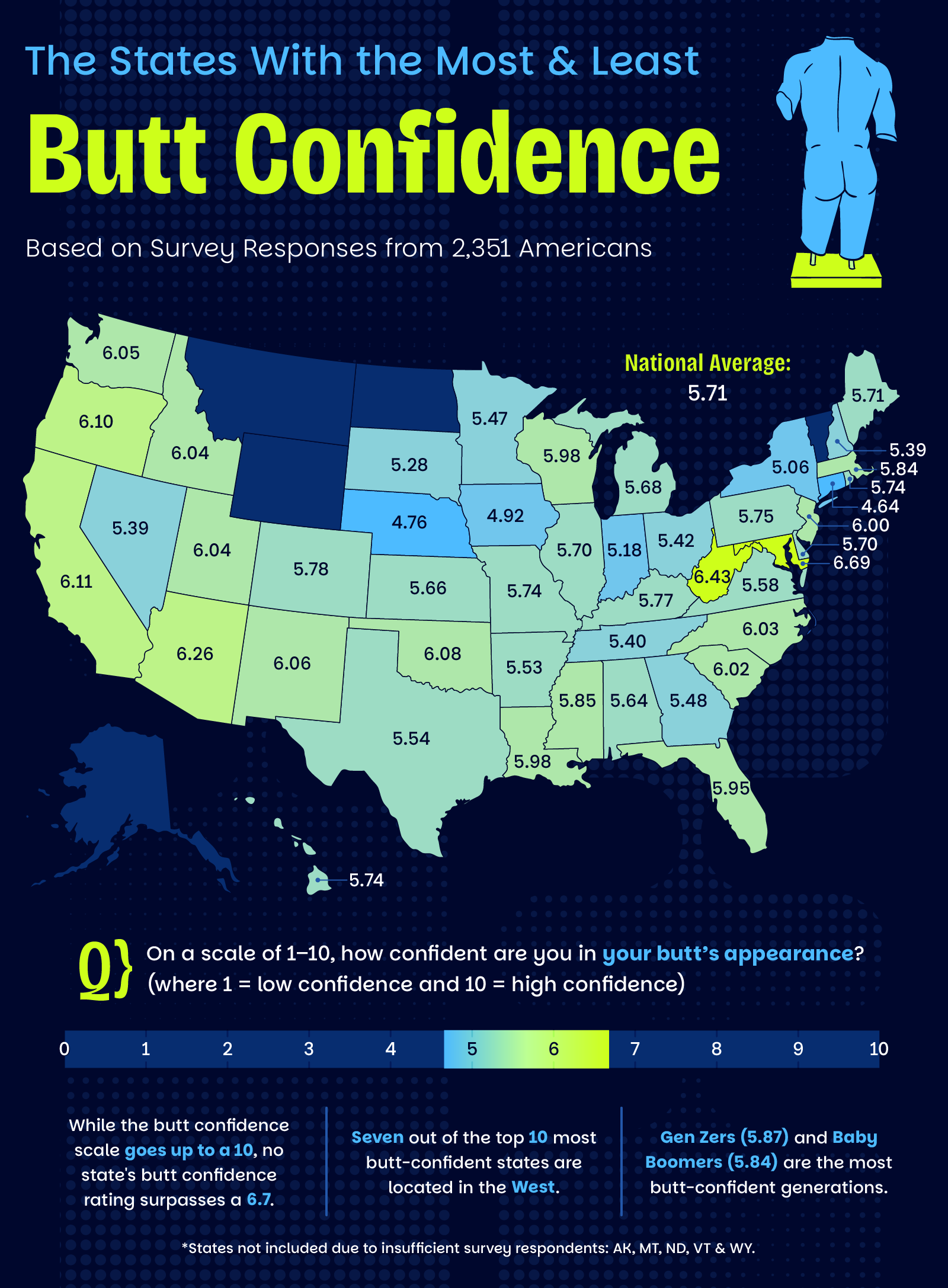
We asked survey respondents to rate how confident they feel about their butts on a scale of 1 to 10, with 1 meaning very low confidence and 10 meaning maximum booty confidence. When we broke the data down by state, some clear front-runners emerged.
Here are the five states with the most butt confidence (and their respective ratings):
- Maryland – 6.69 (out of 10)
- West Virginia – 6.43
- Arizona – 6.26
- California – 6.11
- Oregon – 6.10
Whether it’s the gym gains, the good lighting, or just pure self-love, these states are bringing serious body confidence, and Maryland is embracing its backside the most. West Virginia follows with the second-most butt confidence in the study. What’s more, the western half of the country is really owning it. Seven of the top 10 most butt-confident states are located out west: Arizona, California, Oregon, New Mexico, Washington, Idaho, and Utah.
Here are the five states with the least butt confidence (and their respective ratings):
- Connecticut – 4.64
- Nebraska – 4.76
- Iowa – 4.92
- New York – 5.06
- Indiana – 5.18
Connecticut ranks lowest in butt confidence, with residents giving themselves an average score of just 4.64 out of 10. Nebraska isn’t far behind at 4.76. And most of the states with the least butt confidence are clustered in the Midwest (Nebraska, Iowa, Indiana, South Dakota) and Northeast (Connecticut, New York, New Hampshire). In much of the Midwest and Northeast, daily life tends to revolve more around work and routine than body culture or outdoor living, which could mean less emphasis on appearance and, by extension, a little less confidence about it.
Overall, Americans are only moderately confident in their butts. The average self-rating came in at 5.7 out of 10, and no state scored higher than a 6.7. It’s a reminder that even in a culture that celebrates body positivity and self-expression, many people still have complicated feelings about how they look from behind.
When looking at the data by demographic, a few trends stand out. LGBTQ+ respondents reported slightly lower levels of butt confidence than their non-LGBTQ+ peers, averaging 5.5 out of 10 compared to 5.8. Among generations, Gen Zers (5.87) and baby boomers (5.84) are the most confident in their bums. It makes sense, though — Gen Z has grown up in a culture that’s more vocal about body inclusivity and self-acceptance than any generation before them, and baby boomers are simply past the point of caring what anyone else thinks about their bodies.
America’s Biggest Butt Insecurities
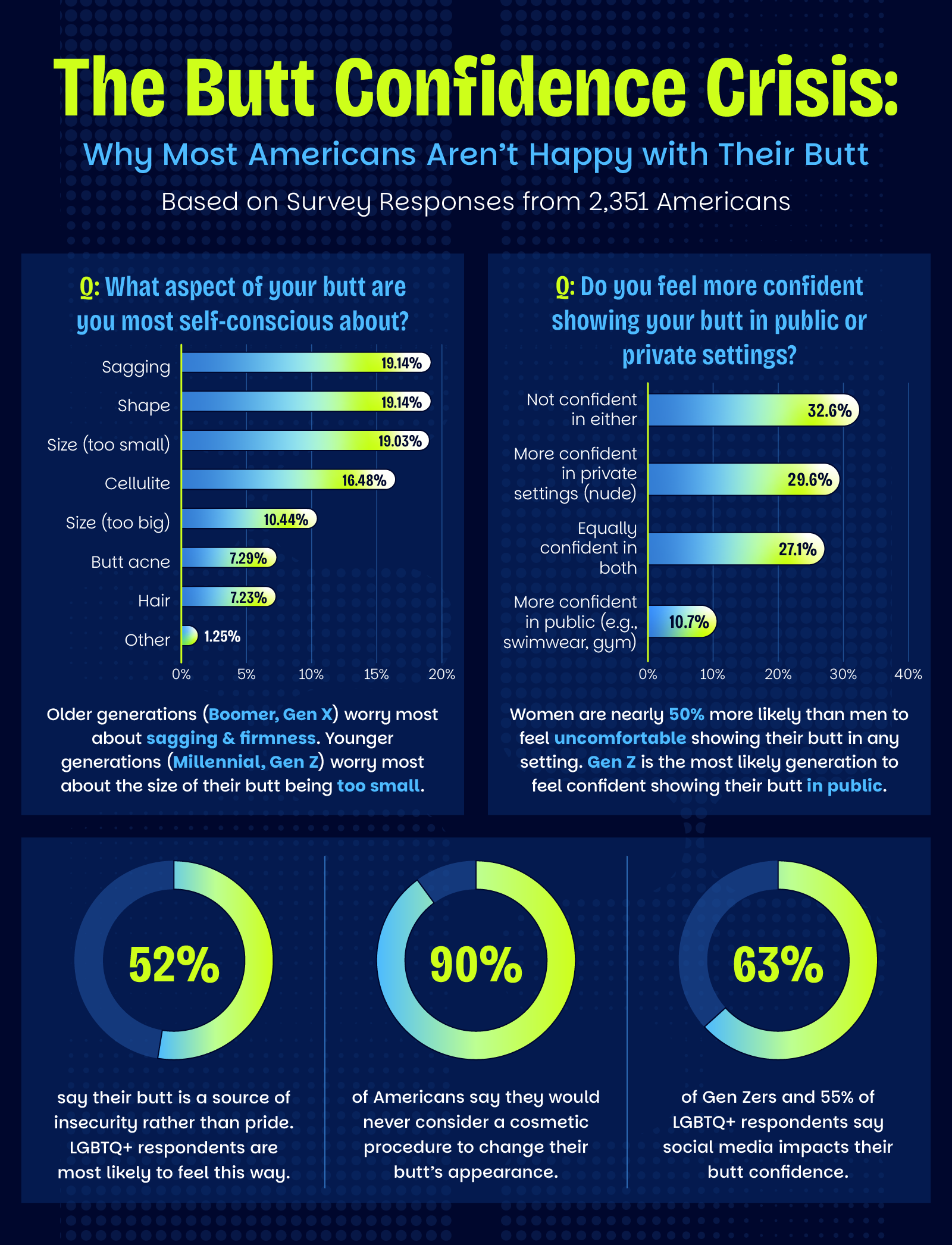
If you’ve ever overanalyzed a mirror selfie or debated whether your jeans are “lifting enough,” you’re not alone. The top sources of butt-related self-consciousness are:
- Sagging or lack of firmness – 19.1%
- Shape – 19.1%
- Size (too small) – 19.0%
- Cellulite – 16.5%
The size-related insecurity says a lot about how far the cultural pendulum has swung: from the waif aesthetic of the ’90s to the Kardashian-era obsession with curves, people are now aspiring to more volume, not less.
For men, the top concern is having a butt that’s too small (25.1%), while women are most self-conscious about cellulite (23.2%). Older generations (boomers and Gen X) tend to focus on firmness, while millennials and Gen Z are more likely to worry about size, specifically their butt being too small.
All in all, body confidence still has a long way to go. When asked, “Do you feel more comfortable showing your butt in public or private settings?”, the largest share of people (33%) say they’re not comfortable showing their butt in any setting — public or private. 30% are more confident in private settings (nude), 27% are equally confident in both, and 11% are more confident in public (e.g., swimwear, gym, tight clothes).
Despite all the cultural noise around body ideals, the vast majority of Americans are keeping things natural. Over 90% of Americans say they would never consider a cosmetic procedure to change their butt’s appearance. For anyone curious about enhancing or caring for their butt in less invasive ways, non-surgical options exist that prioritize comfort and confidence over dramatic change.
Michael Aronwits, RN and Aesthetic Nurse at Bespoke Surgical, sees this trend firsthand:
Despite the pressure people feel from cultural beauty standards, most individuals truly just want to feel like the best version of themselves. What we’re seeing is that patients are prioritizing function and confidence over dramatic or purely aesthetic changes. For anyone curious about caring for or enhancing their butt without going under the knife, there are incredibly effective, non-surgical options that focus on restoring volume, improving skin quality, and even performing better in the bedroom.
Still, generational and identity differences stand out. Millennials are nearly four times more likely than baby boomers to consider cosmetic enhancements (12.1% vs. 3.1%), while LGBTQ+ respondents are almost twice as likely as straight respondents to be open to it (14% vs. 8.2%).
And even as the cultural conversation around butts has evolved, insecurity remains common: more than half of Americans (52%) say their butt is a source of insecurity rather than pride. Men are significantly more likely than women to feel proud of their butts (55% vs. 44%), and interestingly, baby boomers are the most likely to view their butt as a point of pride (54%). For LGBTQ+ respondents, though, those feelings skew more self-critical (55% view their butt as a source of insecurity).
Social media, of course, isn’t helping. Nearly two-thirds of Gen Z (63%) and more than half of LGBTQ+ respondents (55%) say their butt confidence is influenced by what they see online. Between unrealistic influencers and filtered realities, it’s no surprise that even the most self-assured generations are struggling to separate real bodies from the highlight reel.
What is Each State Googling About Their Butts?
Next, we pulled a list of the top butt-related questions people are Googling using Ahrefs keyword explorer. Then we ran this list of questions through Google Trends to find the top-searched booty-related question in every state.
The most searched butt-related questions overall are:
- What is a butt plug? – 5 states
- Can you get pregnant from anal? – 4 states
- How to treat an anal fissure? – 4 states
- What is Ozempic butt? – 4 states
- How to get a bigger butt? – 3 states
- What is an anal fissure? – 3 states
- What is anal bleaching? – 3 states
- How much does a Brazilian butt lift cost? – 2 states
- How to do anal sex? – 2 states
- How to use a butt plug? – 2 states
- What is office chair butt? – 2 states
- Why does my butt itch? – 2 states
When it comes to what people are Googling about their behinds, curiosity knows no bounds. Topping the list is “What is a butt plug?” searched most often in five states: New Hampshire, Oregon, Tennessee, Vermont, Washington, and Wyoming. The once-niche sex toy has gone mainstream in recent years, thanks to the rise of TikTok sex educators and a wave of brands focused on destigmatizing anal play.
But one of the other most-searched questions in four states — “Can you get pregnant from anal?” — hints at some lingering confusion about sex ed topics. Alabama, Arizona, Connecticut, and Illinois all topped the charts with that query, and interestingly, all of these states received a C or lower on their 2025 SIECUS Sex Education State Report Card. It’s a reminder that comprehensive, accessible, and inclusive sex education can make a real difference, and that when answers aren’t clear in the classroom, people often turn to Google instead.
Elsewhere, Americans seem equally fascinated by the medical, aesthetic, and cultural sides of the butt. States like Maryland, Massachusetts, and Utah search for “What is Ozempic butt?” the most. The phrase was born from the rise of GLP-1 weight loss medications and their unintended side effects. Meanwhile, California, Florida, and New York are all fixated on “What is anal bleaching?” which feels right on brand for states that also lead in beauty and cosmetic trends.
As Dr. Evan Goldstein of Bespoke Surgical explains, this surge in curiosity reflects a much bigger shift:
It’s no surprise that people are increasingly curious about the medical and aesthetic nuances of butt health, especially with conversations around GLP-1s and cosmetic trends taking over social media. The most important thing to know is that there are safe, medically backed, minimally invasive options to address these issues. I always ask my patients where they might feel limited, both in and out of the bedroom, and then help guide them toward choices that feel aligned with their goals.
But not every question is so glamorous. From “Why does my butt itch?” (Kentucky and Nebraska) to “Why does my butt sweat so much?” (Indiana and South Carolina), some states are just trying to solve everyday butt problems. And then there’s “Office chair butt,” the most searched in New Mexico and Oklahoma, proof that remote work has its downsides, too. Whether it’s about aesthetics, anatomy, or anxiety, America’s collective curiosity about butts is alive and pretty revealing.
Your Butt Questions, Answered by Dr. Evan Goldstein
To help answer some of America’s most Googled butt questions, we turned to Dr. Evan Goldstein. As one of the country’s leading experts in sexual wellness and anal health, Dr. Goldstein offers his take on a few of the internet’s most pressing questions about the butt.
Q: How do I treat an anal fissure?
A: Start with the basics: ease your stool strain with fiber, water, and stool softeners, stick to soothing topicals and warm baths, and pause any anal play that’s making it worse. If you’re still hurting after a few weeks, it’s time to see a specialist who can perform exams (like an anoscopy) to uncover the root cause and decide whether in-clinic options or surgical fixes are on the table. For a deeper dive and step-by-step treatment paths, see the full breakdown here: Anal Fissure Treatment at Bespoke Surgical.
Q: How do I get rid of butt acne?
A: Start by clearing out the basics, like regular showers (especially post-workout), breathable underwear or sleeping naked, and switching out sweaty sheets and dirty underwear. Add in smart skincare: a gentle scrub to exfoliate pores, a warm compress for active bumps, and quick-drying creams to soothe irritation. Most importantly, stop harsh scrubbing, avoid tight clothes and heavy occlusive creams, and if scarring’s hanging around, it’s worth seeing a skin professional to assess lasers or peels.
Q: How do I prepare for anal sex?
A: Before bottoming, you’ll want to empty what you can and then gently cleanse with a proper douching system, preferably an isotonic and iso-osmolar solution – like the one from Future Method – this keeps your rectum and microbiome balanced while letting you go in with confidence. Go slow, use small-to-moderate amounts of liquid, and avoid over-prepping, because “more” doesn’t mean “better” when douching. For the full breakdown and safe-prep protocol, see our deeper guide here: Anal Douche Guide: How to Douche and Prepare for Anal Sex.
Who’s Googling About Their Butt and Why?
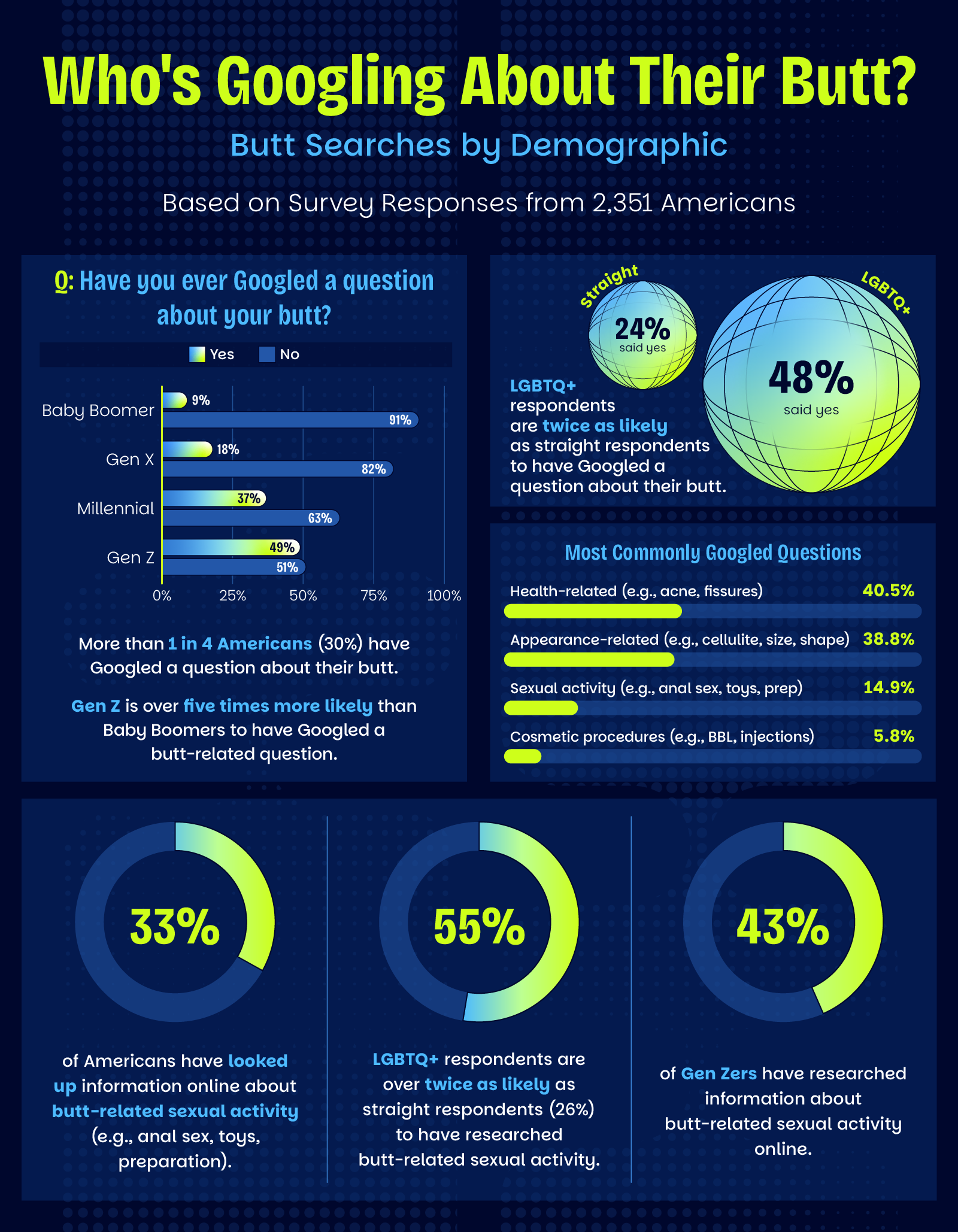
According to our survey, nearly 1 in 3 Americans (30%) have Googled a question about their butt. But it’s Gen Z leading the way: almost half (49%) say they’ve searched a butt-related question, compared to just 9% of baby boomers. That gap could speak to generational comfort levels around sexual health and body talk, or maybe Gen Z just refuses to stay uninformed. After all, this is a generation that grew up with Google as a first responder, not a last resort. LGBTQ+ respondents are also searching at notably higher rates (48% compared to 24% of straight respondents), suggesting that online spaces might feel like safer, more inclusive sources of information about sexual wellness and body care.
And when people do turn to Google, their butt-related questions are most often about health (41%) (e.g., acne, fissures, sweating, itching) and appearance (39%) (e.g., cellulite, size, shape, bleaching). Sex-related questions only made up 15% of self-reported searches, though the actual Google Trends data tells a slightly different story. Given the popularity of queries like “what is a butt plug” and “how to do anal sex,” it’s fair to assume people might be searching more than they’re letting on.
When it comes to Googling specifically about anal sex activity, curiosity climbs even higher. One in three Americans (33%) admits they’ve gone down that particular search rabbit hole, but LGBTQ+ respondents are especially open about it. 55% say they’ve researched butt-related sexual topics online, more than double the 26% of straight respondents. The trend also skews young: 43% of Gen Zers have searched for this kind of information, compared to 24% of Gen Xers and just 16% of boomers.
So why do we head to Google for these questions instead of, say, a doctor or a friend? The answer is refreshingly practical. Nearly two-thirds (62%) say it’s simply faster and easier, while another 25% cite a need for anonymity. Only a small share admit it’s about embarrassment — just 7% say they’d feel uncomfortable asking a doctor, and 6% wouldn’t ask friends or family. And while most people are at least somewhat confident in what they find, the trust isn’t absolute: 70% believe Google’s answers are “somewhat accurate”, and just 11% consider them “very accurate.” 19% say the answers are “not very accurate.”
The “Bottom” Line
If there’s one thing this study makes clear, it’s that America’s relationship with its backside is endlessly curious and evolving. From state-by-state insecurities to late-night Google searches, people are talking about their butts — and that’s a good thing. The data shows a real cultural shift toward honesty and self-awareness: younger generations and LGBTQ+ communities are asking more questions, breaking taboos, and taking ownership of their sexual health and body confidence. Whether it’s about appearance, comfort, or pleasure, the conversation around butts isn’t just about vanity. It’s about empowerment, education, and embracing every part of yourself.
And when you’re ready for answers you can trust, skip the search bar and go straight to the experts at Bespoke Surgical. We offer comprehensive anal wellness services, from medical care to aesthetic treatments, all grounded in expertise, compassion, and inclusivity.
Methodology
This study combined a Google Trends analysis with a U.S. survey to explore Americans’ attitudes, behaviors, and curiosities related to their butts.
For the Google Trends portion, we first compiled a list of the 100 most frequently searched butt-related questions using Ahrefs Keyword Explorer. This list was then analyzed through Google Trends to identify the top-searched question in each U.S. state over the past 12 months. The results were mapped to reveal regional differences and national patterns in butt-related search behavior.
In addition to the search analysis, a survey was conducted among 2,351 U.S. adults aged 18 to 77 years old across 45 states in October 2025. The survey gathered insights into respondents’ levels of butt confidence, sources of insecurity, and motivations for researching butt-related topics online. States excluded from the survey due to limited sample size include Alaska, Montana, North Dakota, Vermont, and Wyoming.
Fair Use
You are welcome to use, reference, and share non-commercial excerpts of this study with proper attribution. If you cite or cover our findings, please link back to this page so readers can view the full methodology, charts, and context.
About the Author

Consistent, proactive, and thoughtful healthcare is not only a priority, it is a demand by men who live well. Bespoke Surgical is built on this understanding. Today's modern, urban male has become adept at making the most of life, believing in living fully and completely in all aspects of work, fitness, relationships, and family. This makes excellent health more important than ever.
Join Our Newsletter
Subscribe to receive exclusive content, new product information, and the latest news.
Stay Connected
Featured products
Read More
Education
The Science of Anal Sex
Get to Know Your Inner A**hole For many, sharing sexual pleasure may be a form...
Uncategorized
What LGBTQ+ Patients Reveal—and Hide—from Their Doctors
Navigating the healthcare system isn’t always straightforward, especially for LGBTQ+ individuals, who often face unique...
General
Survey: Are Chronically-Online Americans Having More or Less Sex?
We know, we know. Screen time gets blamed for everything. Burnout, bad sleep, digital dating...
