General, Health, Aesthetics
The Average Penis Size in Every State
February 22, 2026 by Bespoke Surgical
Penis size is one of those topics that manages to be everywhere and nowhere at once: joked about constantly, discussed quietly, and treated like a high-stakes scoreboard even though bodies don’t come with a single “right” measurement. It’s also a surprisingly durable source of anxiety and cultural noise — the kind that can shape self-image, dating dynamics, and even how people talk about sex in the first place. So instead of adding another hot take to the pile, we wanted to look at what people actually report about their own bodies, and what those numbers can (and can’t) tell us about how penis size relates to confidence, comparison, and partner feedback in real life.
To do that, Bespoke Surgical surveyed over 3,000 U.S. adults and asked respondents with a penis to self-report their flaccid and erect length to find the average penis size in every state, along with the states with the biggest “growers.” We also asked about their broader experiences around penis size, including how they think and talk about it, whether they’ve measured or compared themselves, and what they’ve heard from partners.
Finally, we widened the lens to include women and respondents without a penis for questions about preferences and perceptions, including whether society overemphasizes penis size, what matters more in bed, and how much weight people actually place on size when it comes to real-world attraction and intimacy.
Key Findings
- The average self-reported erect penis length in the U.S. is 6.34 inches.
- The average man grows 3.09 inches between being flaccid and erect.
- 67% of respondents with a penis overestimate their penis size, while 28% underestimate their penis size when talking with friends and potential romantic partners.
- Most feel good about their penis size: 82% say they’re confident or very confident.
- 88% say they’ve measured their penis size before, and 57% say they often compare their penis size to others.
- 73% say a partner has commented on the size of their penis.
- 60% of all respondents (which includes multiple genders) say girth matters more than length when it comes to penis size.
- 89% of all respondents believe society puts too much emphasis on penis size.
- Most respondents say emotional connection, chemistry, and compatibility matter more in bed than penis size.
The Average Penis Size by State
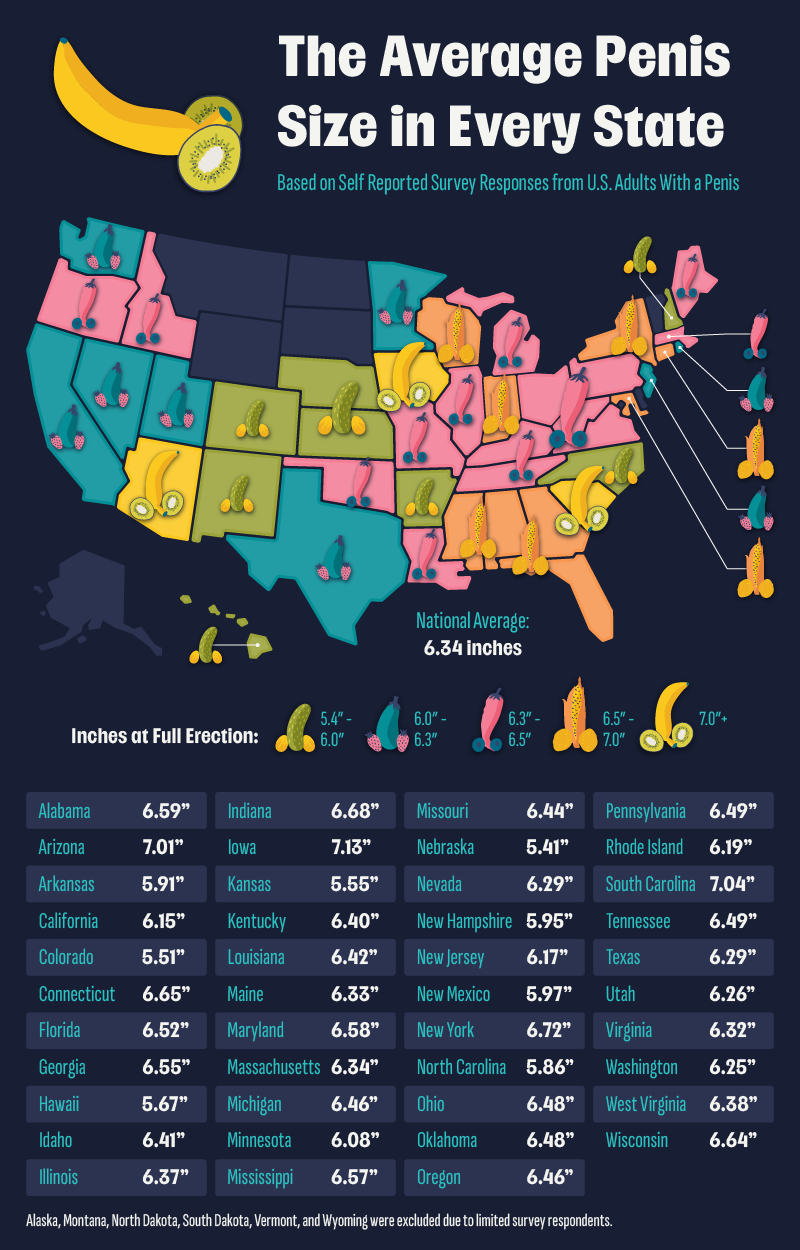
Penis size is often treated like a cultural fixation, but it’s rarely discussed with real numbers attached. Based on survey responses, the average self-reported erect penis length clocks in at 6.34 inches.
The five states with the highest average penis length at full erection are:
- Iowa (7.13 inches)
- South Carolina (7.04)
- Arizona (7.01)
- New York (6.72)
- Indiana (6.68)
Iowa’s average (7.13 inches) is 12.5% longer than the national average, while South Carolina’s average (7.04 inches) is about 11% longer. The top five results suggest there isn’t a single “type” of place that dominates the upper end of the list. Zooming out, though, one regional pattern does start to emerge: four of the top 10 states with the longest self-reported averages are in the South — South Carolina (#2), Alabama (#8), Maryland (#9), and Mississippi (#10).
The States With the Biggest “Growers”
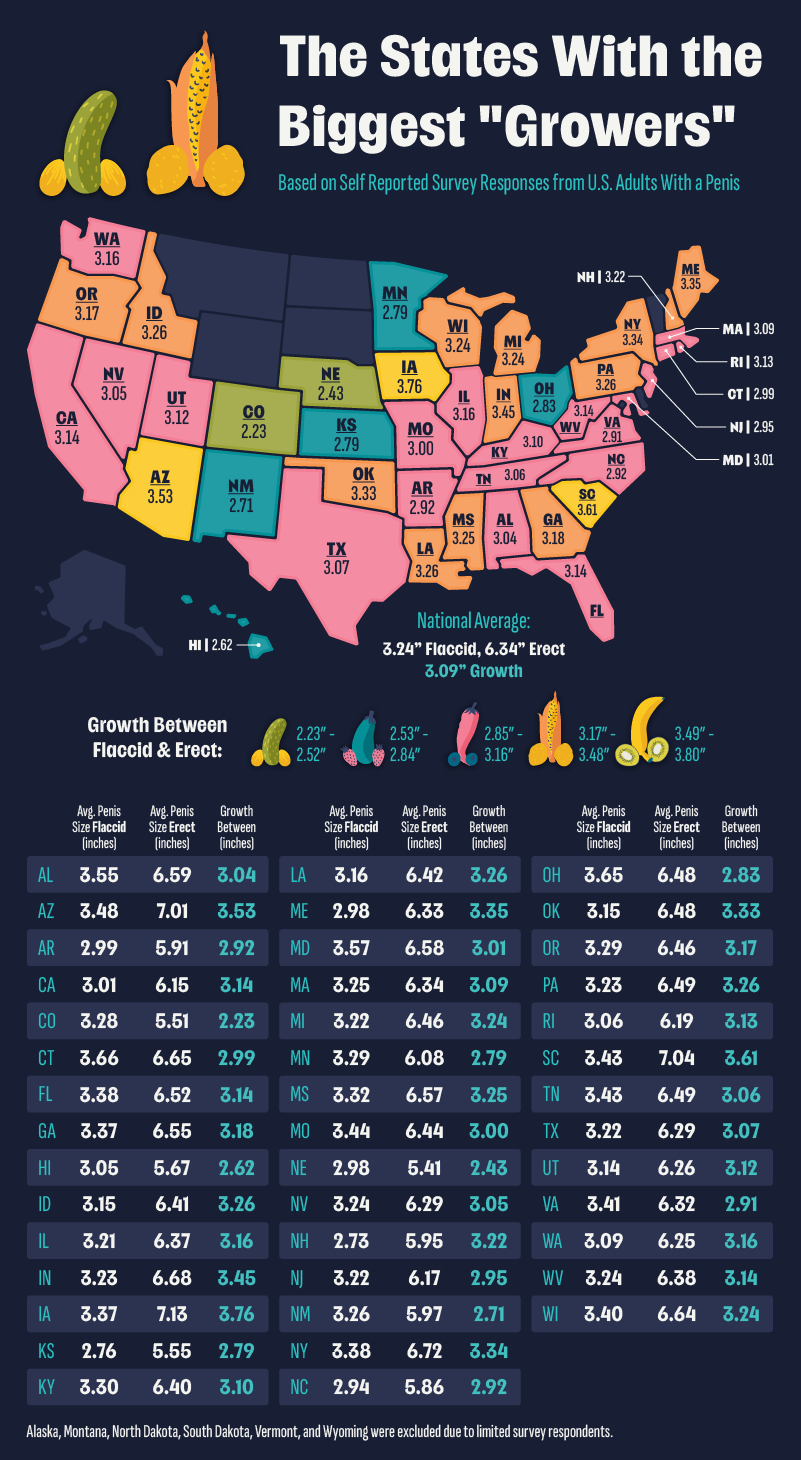
What you see isn’t always what you get. On average, respondents reported growing 3.09 inches between being flaccid and erect, which is basically the data-driven version of the old “grower vs. shower” conversation. A “grower” just means someone whose flaccid length is smaller relative to their erect length, so the difference looks more dramatic once they’re aroused. In other words, some people don’t “show” much at rest, but they grow significantly when it counts, and that’s a totally normal pattern of variation.
The five states with the biggest “growers” are:
- Iowa: 3.37″ (flaccid) → 7.13″ (erect) = +3.76 inches
- South Carolina: 3.43″ (flaccid) → 7.04″ (erect) = +3.61 inches
- Arizona: 3.48″ (flaccid) → 7.01″ (erect) = +3.53 inches
- Indiana: 3.23″ (flaccid) → 6.68″ (erect) = +3.45 inches
- Maine: 2.98″ (flaccid) → 6.33″ (erect) = +3.35 inches
In this survey, the biggest reported “growers” came from a mix of states, again led by Iowa, where respondents averaged 3.37 inches flaccid and 7.13 inches erect — a jump of +3.76 inches, followed by South Carolina, Arizona, Indiana, and Maine. And because this topic is rarely discussed without at least a little social pressure, the survey also suggests that people don’t always describe their bodies the way they measure them: 67% of respondents said they tend to overestimate their penis size when talking with friends or potential romantic partners, while 28% said they underestimate it.
Penis Confidence, Comparisons, and Commentary
Penis Confidence Gaps
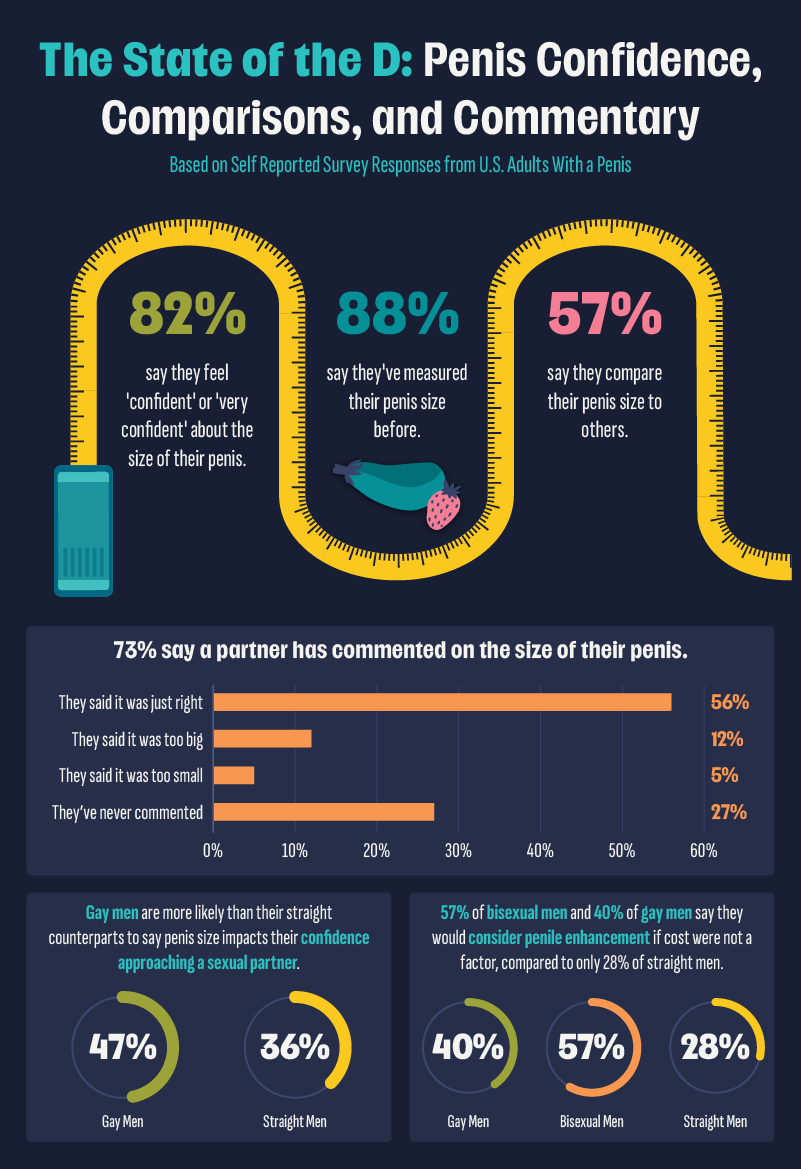
After looking at how much size can shift between flaccid and erect, the next question is a little more psychological: how do people actually feel about what they’re working with? When respondents were asked, “How confident are you in the size of your penis?”, a large majority (82%) said they feel “confident” or “very confident.” There was one notable generational gap, though: Gen Z respondents reported slightly lower confidence than baby boomers (78% vs. 84%). Younger people are growing up in a world where comparison is constant (social media, dating apps, porn that’s basically an algorithm), and that kind of always-on measuring stick can make it harder to feel solid about your own body.
Confidence aside, measuring penis length is nearly universal. 88% of respondents said they’ve measured their penis size before, which makes it less of a niche curiosity and more of a rite of passage. LGBTQ+ respondents were even more likely to have measured themselves (93%) compared to non-LGBTQ+ respondents (85%).
Comparison Happens
And then there’s penis size comparison — the thing most people pretend they don’t do, but many absolutely do. More than half (57%) said they’ve compared their size to others (whether in person, porn, or a locker-room moment), and the gap by sexuality is striking: 84% of gay men said they’ve compared themselves, versus 45% of straight men.
The context around confidence and comparison raises another question: how many respondents have had a romantic partner comment on the size of their penis? In this survey, 73% of respondents said a partner has commented on the size of their penis. Among those who’ve gotten a comment, 56% were told it was “just right,” 12% heard “too big,” and only 5% were told it was “too small.” It’s not exactly a scientific cure for insecurity, but it does suggest that in real-life bedrooms, feedback tends to be more reassuring than critical.
Does Penis Size Affect Confidence With New Partners?
When asked whether penis size impacts their confidence when approaching a new sexual partner, 61% said it does not, while 39% said it does. There’s also a noticeable gap by sexuality: 47% of gay men said their penis size affects their confidence in approaching a partner, compared with 36% of straight men, which fits with the idea that when you’re dating and having sex with other men, you may be more aware of direct points of comparison. Even so, most respondents don’t seem to carry that anxiety into the rest of their identity: 93% said they don’t feel the need to “overcompensate” for their penis size in other areas of life, like career, appearance, cars, or spending habits.
And yet, curiosity (or the allure of an upgrade) still shows up when you ask a purely hypothetical question. 35% of respondents said they’d consider getting a penile enhancement procedure if cost weren’t a factor. That number jumps to 51% among respondents who reported an erect penis length of 5 inches or less. Interest also varies by orientation: 57% of bisexual men and 40% of gay men said they’d consider it if cost weren’t an issue, compared with 28% of straight men.
Society Fixates on Penis Size More Than Partners Do
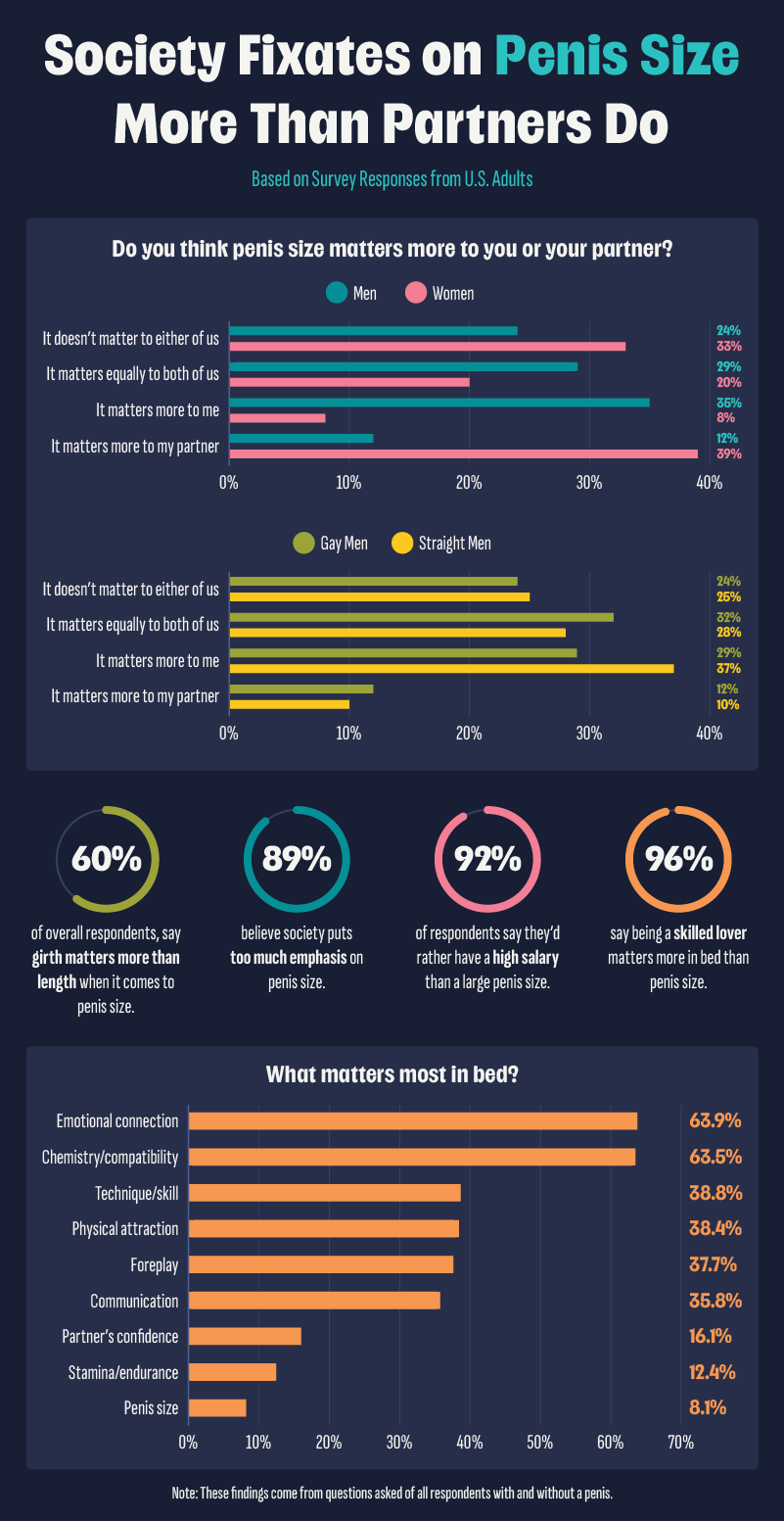
At this point in the survey, the lens widens: these next questions were opened up to women and respondents without a penis as well. When asked, “Do you think penis size matters more to you or your partner?”, the largest share of respondents (31%) said it doesn’t matter to either partner. But the interesting part is how the answers shift when you slice the data up by demographic. Men were most likely to say penis size matters more to them personally, while women were most likely to say it matters more to their partner — a split that suggests a lot of size anxiety may be self-imposed.
Orientation adds another layer. Straight and bisexual men were more likely to say size matters more to them, while gay men were most likely to say it matters equally to both of us, which makes intuitive sense if you’re dating someone with the same anatomy and comparisons feel more direct.
Stepping back, though, the survey suggests most people think the cultural obsession with penis size has gotten out of hand. 89% of respondents said society puts too much emphasis on penis size, and Gen Z was the most critical by far, with 94% saying the focus is excessive. Even the generation raised on constant online comparison is, at this point, over it.
What Actually Matters in Bed
Next, when it comes to penis size specifics, 60% of respondents said girth matters more than length. 63% of both straight men and women prioritize girth over length, while gay men flipped the script: 60% said length matters more (vs. 40% for girth). Preferences aren’t universal, obviously, but the bigger takeaway is that “size” isn’t a single idea; people mean different things when they talk about it.
And then the survey basically closes the loop on what matters outside the group chat. 92% of respondents said they’d rather have a high salary than a large penis size. More importantly, an overwhelming 96% said being a good or skilled lover matters more in bed than penis size. When respondents were asked what matters most in bed, emotional connection (63.9%) and chemistry/compatibility (63.5%) both far outpaced physical attraction (38.4%) — and penis size ranked last by a wide margin. If anything, the data suggests cultural fixation is louder than real-life priorities, and that the thing people worry about most may be the thing their partners are thinking about least.
As Dr. Evan Goldstein, founder of Bespoke Surgical, puts it: “It’s no secret we’re culturally obsessed with inches. Guys inflate, round up, add a little ‘creative math,’ and this study proves it. But when it actually comes down to it, people care a lot more about connection, both mentally and physically. At Bespoke Surgical, we see it every day: a great experience has far more to do with comfort and confidence than size. When you take the guesswork out of sex, through education or a science-backed prep routine like Future Method, you realize compatibility and skill matter a whole lot more than length or girth.”
Closing Thoughts
The data shows meaningful variation by state and a real “grower vs. shower” spread, but it also shows that many respondents feel generally comfortable with their bodies, and partner feedback tends to skew more reassuring than critical. Zooming out, the strongest throughline isn’t a single “ideal” number of inches. It’s that size anxiety is often louder in conversation (and culture) than it is in real-life priorities.
That perspective is central to Bespoke Surgical’s work. As a sexual health-focused practice led by Dr. Evan Goldstein, Bespoke Surgical treats patients through care that intersects with intimacy, confidence, and quality of life — with an emphasis on creating a nonjudgmental space to talk about sexual health and wellness. If you’re looking for trusted, practical education, our health resources are a helpful place to start.
Methodology
To compile the insights in this study, Bespoke Surgical surveyed 3,308 U.S. adults: 2,808 respondents with a penis (including men) and 500 respondents without a penis (including women). The survey ran from December 2–12, 2025.
Respondents with a penis were asked to self-report their erect length; we used those responses to calculate the average self-reported erect penis size by state and nationwide. We also asked respondents with a penis to measure and report their flaccid length, which allowed us to estimate the average change between flaccid and erect (including the states with the biggest “growers”). Alaska, Montana, North Dakota, South Dakota, Vermont, and Wyoming were excluded from state-level results due to limited sample sizes.
Additional questions explored respondents’ perceptions and experiences around penis size, including measuring habits, comparison behaviors, partner commentary, attitudes toward penile enhancement, and beliefs about what matters most in bed.
Fair Use
You are welcome to use, reference, and share non-commercial excerpts of this study with proper attribution. If you cite or cover our findings, please link back to this page so readers can view the full methodology, charts, and context.
About the Author

Consistent, proactive, and thoughtful healthcare is not only a priority, it is a demand by men who live well. Bespoke Surgical is built on this understanding. Today's modern, urban male has become adept at making the most of life, believing in living fully and completely in all aspects of work, fitness, relationships, and family. This makes excellent health more important than ever.
Join Our Newsletter
Subscribe to receive exclusive content, new product information, and the latest news.
Stay Connected
Featured products
Read More
General
Would You Let AI Replace Your Partner, Doctor, or Therapist? [A Survey]
Artificial intelligence has quickly become part of everyday life. Increasingly, it’s also becoming part of...
General
What’s Your Number? The Average Number of Sexual Partners by State in 2026
Five years ago, Bespoke Surgical asked Americans a question that almost everyone has been asked...
Uncategorized
What LGBTQ+ Patients Reveal—and Hide—from Their Doctors
Navigating the healthcare system isn’t always straightforward, especially for LGBTQ+ individuals, who often face unique...
