General, Health
Would You Let AI Replace Your Partner, Doctor, or Therapist? [A Survey]
July 27, 2026 by Bespoke Surgical
Artificial intelligence has quickly become part of everyday life. Increasingly, it’s also becoming part of our personal lives. From asking embarrassing health questions to seeking dating advice, more Americans are turning to AI for conversations they may not feel comfortable having with anyone else. That shift isn’t happening in isolation. Four in 10 Americans (40%) now use AI chatbots every day, while another 29% use them several times a week. With these tools becoming a regular part of daily life, it’s no surprise that people are beginning to rely on them for far more personal conversations.
As chatbots become increasingly sophisticated, the line between convenience and companionship continues to blur. Could an AI replace a therapist for someone who can’t afford regular sessions? Would people trust a chatbot with sensitive health questions before seeing a doctor? And as AI companions become more realistic, how many Americans are open to the idea of a romantic—or even sexual—relationship with a chatbot? To find out, we surveyed Americans about how comfortable they would be letting AI take on deeply personal roles, from romantic partner and sexting companion to therapist, physician, and financial planner. We also explored what factors, such as cost, privacy protections, transparency, and accuracy, make people more or less willing to trust AI with high-stakes decisions.
The results reveal where Americans still draw the line between human connection and artificial intelligence—and where that line may already be starting to disappear.
Americans Are Bringing AI Into Their Love Lives
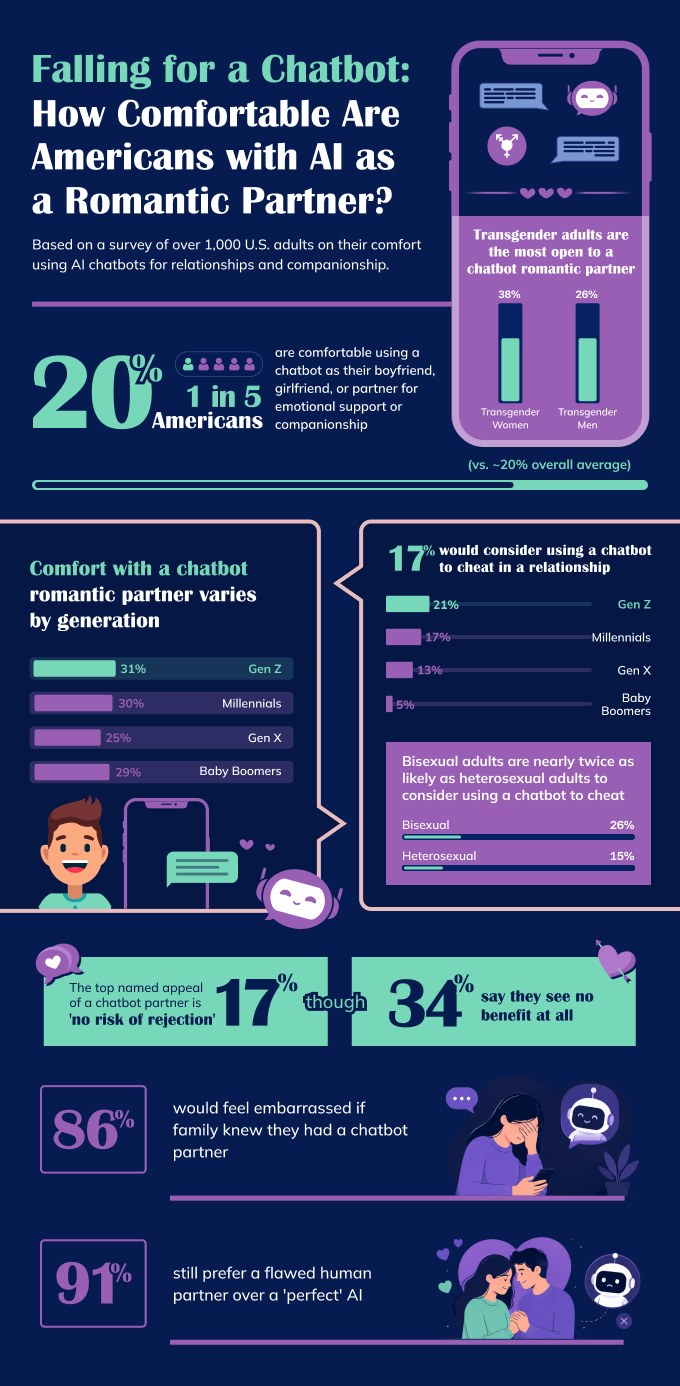
For many Americans, AI has become more than a productivity tool—it’s becoming a sounding board for personal relationships. Our survey found that one-third of Americans (33%) have already used a chatbot for dating or relationship advice, suggesting that turning to AI for help navigating romance is becoming increasingly common.
For some, that curiosity extends beyond advice. One in five Americans (20%) say they would be comfortable using a chatbot as a boyfriend, girlfriend, or romantic partner for emotional support or companionship. As AI conversations become more natural and personalized, some users appear willing to explore emotional connections with technology in ways that would have seemed far-fetched just a few years ago.
The survey also found that 14% of Americans have used a chatbot for flirting, sexting, or romantic roleplay, highlighting AI’s growing role in people’s intimate lives. Another 17% say they would consider using a chatbot to cheat on a romantic partner, raising new questions about where people draw the line between fantasy, emotional intimacy, and infidelity in the age of artificial intelligence.
Despite these emerging trends, Americans remain overwhelmingly loyal to real human relationships. More than 9 in 10 respondents (91%) said they would rather have a flawed human partner than a perfect AI companion. While AI may offer convenience, anonymity, or even a judgment-free space to explore relationships, the vast majority of people still believe a genuine human connection is something technology can’t replace.
While romance may be one of the most attention-grabbing ways people are using AI, relationships aren’t the only area where chatbots are becoming trusted companions. Increasingly, Americans are also relying on AI to answer questions about their physical and mental health.
When It Comes to Health, Americans Trust AI More Than Ever
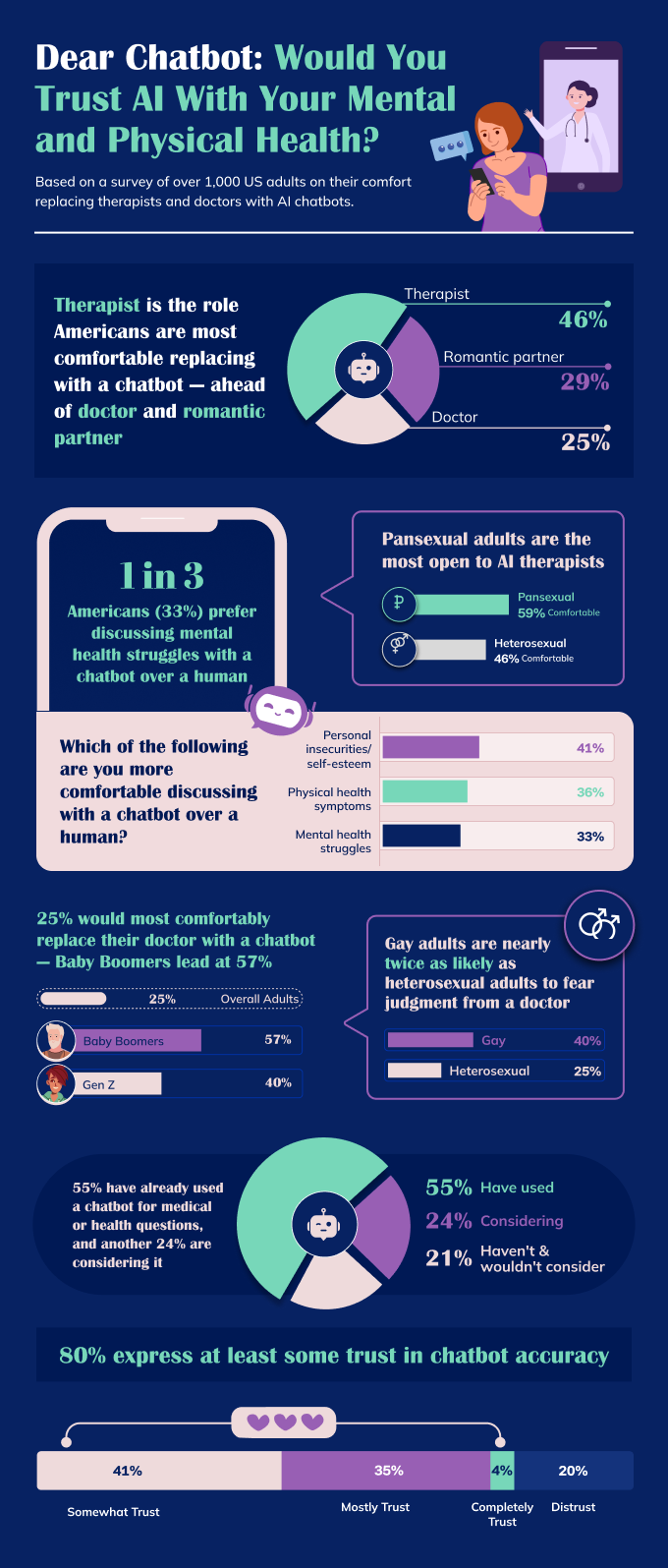
AI isn’t just changing how Americans date—it’s changing how they seek health information. Our survey found that 55% of Americans have already used a chatbot to ask medical or health-related questions, while another 24% say they’re considering it. Together, that means nearly 4 in 5 Americans have either used or are open to using AI to better understand their health.
Many respondents also admitted they feel more comfortable asking AI questions that they might hesitate to bring up with another person. More than one-third (36%) said they’d rather discuss physical health symptoms with a chatbot than a human, while one in three said they would feel more comfortable discussing mental health struggles with a chatbot than with another person. The appeal is understandable: chatbots are available around the clock, don’t require appointments, and offer a judgment-free space to ask questions that may otherwise feel embarrassing or difficult to discuss.
That trend is especially apparent when it comes to mental health. Nearly half of Americans (43%) have already used a chatbot for mental health support, making it one of the most common personal uses for AI. When asked which professional role they’d be most comfortable replacing with a chatbot, 46% chose a therapist, compared to 29% for a romantic partner and 25% for a medical doctor. While AI isn’t replacing licensed mental health professionals, many people appear to be using it as a first stop for emotional support, stress management, or working through difficult feelings.
Interestingly, LGBTQ+ respondents revealed another important reason people may be turning to AI. Nearly 40% of gay respondents said they’d ask a chatbot questions they were afraid a doctor might judge them for, compared to about one-quarter of heterosexual respondents. At the same time, LGBTQ+ adults were also among the least likely to say they’d replace their doctor with AI, suggesting they see chatbots as a way to prepare for healthcare conversations—not a substitute for affirming, knowledgeable medical providers.
As Dr. Evan Goldstein, founder of Bespoke Surgical, puts it: “I see patients every day who delayed seeking care because they were embarrassed or afraid of being judged, especially within the LGBTQ+ community. If AI helps someone ask a question they otherwise wouldn’t or gives them the confidence to seek care, that’s a positive thing. But it should only be the starting point, not the destination. Nothing can replace the expertise and trust that come from an affirming healthcare provider.”
Trust, however, remains conditional. When asked what would make them more comfortable relying on AI, respondents most often pointed to source citations (41%) and built-in fact-checking (35%). The findings suggest Americans aren’t looking for AI to replace medical expertise—they want AI that is transparent about where its information comes from.
These findings highlight both the promise and the limitations of AI in healthcare. Chatbots can make health information more accessible, help people organize their thoughts before an appointment, and reduce barriers to asking sensitive questions. But they can’t perform physical exams, order diagnostic tests, or provide individualized medical care. AI may be changing how people begin their healthcare journey, but trusted healthcare professionals remain an essential part of it.
Closing Thoughts
Artificial intelligence is rapidly becoming part of our everyday lives, and this study shows that many Americans are increasingly comfortable bringing it into deeply personal spaces—from dating advice and emotional support to questions about their physical and mental health. While AI offers convenience, privacy, and instant access to information, most respondents still recognize that some things are difficult to replace with technology.
For LGBTQ+ individuals, especially, the findings highlight an important opportunity. When people worry about stigma or judgment, AI may help them ask questions they otherwise wouldn’t. But those conversations should ultimately lead to affirming, evidence-based healthcare from providers who understand their unique needs and experiences.
At Bespoke Surgical, we believe everyone deserves access to accurate sexual health information and compassionate, judgment-free care. Whether you’re navigating a new relationship, have questions about your sexual health, or are looking for an LGBTQ+ affirming healthcare provider, our team is here to help. Explore our educational resources or schedule a confidential consultation to receive personalized care from experts who put your health first.
Methodology
This data is based on a survey of over 1,000 respondents across America, collected in June and July of 2026. Data was analyzed across states, generations, gender identities, and sexual orientations to identify national and regional trends related to intimacy and sexual behavior.
Respondents were asked questions about their comfort using AI chatbots in place of a romantic partner, doctor, and therapist—covering trust, cost, and privacy factors driving that preference, plus more sensitive topics like sexting/roleplay, cheating, and AI-generated porn.
Fair Use
You are welcome to use, reference, and share non-commercial excerpts of this study with proper attribution. If you cite or cover our findings, please link back to this page so readers can view the full methodology, charts, and context.
Featured products
Read More
General
What’s Your Number? The Average Number of Sexual Partners by State in 2026
Five years ago, Bespoke Surgical asked Americans a question that almost everyone has been asked...
General
The Average Penis Size in Every State
Penis size is one of those topics that manages to be everywhere and nowhere at...
Uncategorized
What LGBTQ+ Patients Reveal—and Hide—from Their Doctors
Navigating the healthcare system isn’t always straightforward, especially for LGBTQ+ individuals, who often face unique...
