Most people do not think twice about how long they spend in the bathroom. But whether someone is straining to finish a bowel movement, scrolling TikTok, answering a text, or grabbing a few extra minutes of peace, a quick toilet trip can turn into much more.
To find out how much time Americans spend on the toilet, Bespoke Surgical surveyed over 3,000 people across the country about their bathroom routines. The results reveal which states linger the longest, how phones and work have followed people into the bathroom, and why many Americans would rather hold it than poop in a public restroom.
Here is what the average bathroom break looks like in America today.
Key Findings
- Americans spend 8.83 minutes on the toilet during a typical poop session. Dr. Evan Goldstein recommends spending 30 seconds or less on the toilet while pooping.
- Americans spend nearly six full days (or 142 hours) on the toilet each year.
- The mobile apps that keep people occupied the longest on the toilet are Instagram, Facebook, and TikTok.
- Americans spend an average of two days and 10 hours per year scrolling social media while on the toilet.
- The average American spends about 15 hours per year texting on the toilet; nearly two full workdays.
- Work follows people into the bathroom. One-third of Americans (33%) work from the toilet, and over one in five (21%) have taken work phone calls from the toilet.
- Seventy-nine percent of Americans are poop-shy in public, avoiding pooping at work or public bathrooms whenever possible.
- Nearly 41% of people say they lose track of time while sitting on the toilet, and 56% admit to lingering on the toilet for extra “me time.”
How Long People In Each State Spend on the Toilet
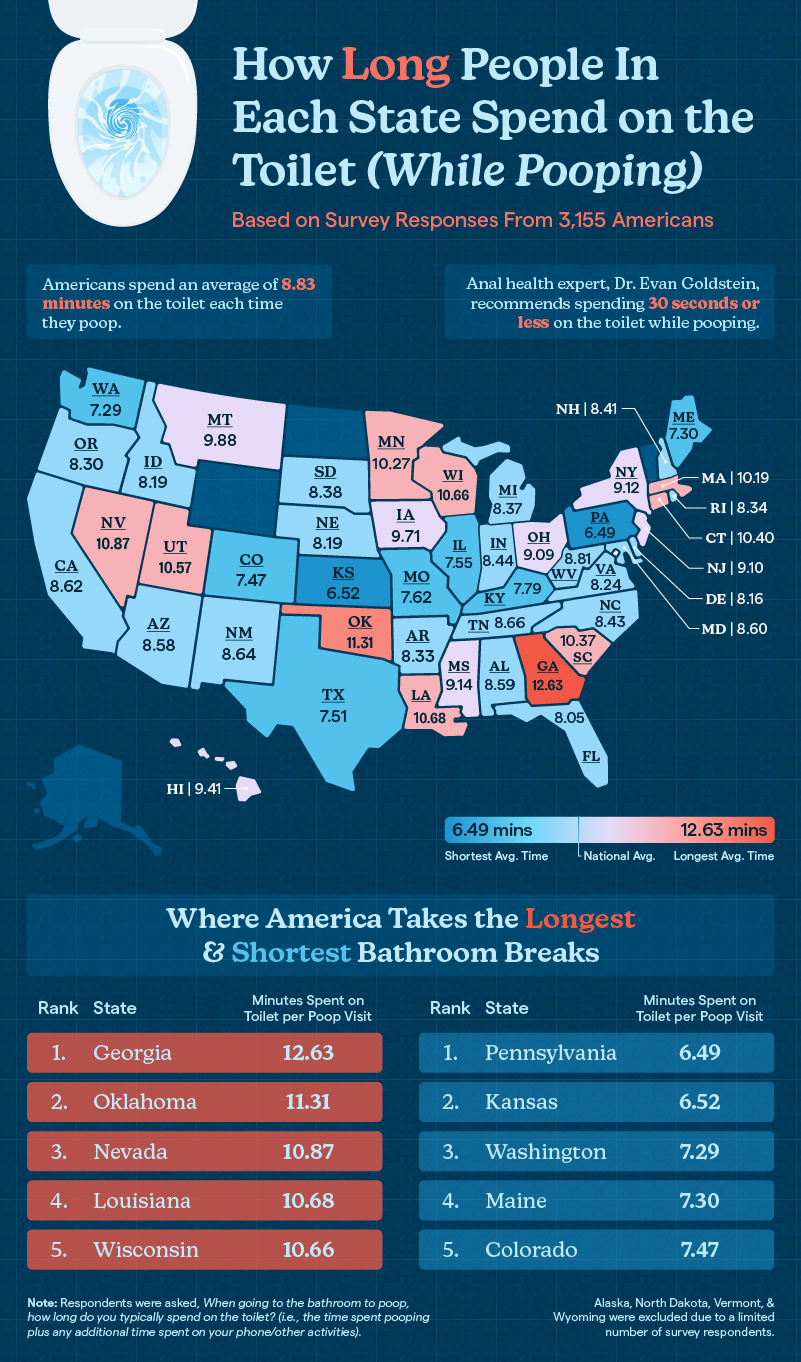
A bathroom break may feel quick, but the average American spends 8.83 minutes on the toilet each time they poop. That figure includes the time spent having a bowel movement as well as any scrolling, texting, or other activities that keep people seated a little longer. Dr. Evan Goldstein says the actual act of pooping should take 30 seconds or less, making the average visit notably longer than ideal.
Dr. Goldstein explains: “What stands out is how much of a bathroom visit may have nothing to do with actually having a bowel movement. Your phone can turn a quick trip into several extra minutes of sitting without you realizing it. So, instead, only go when you feel the urge, avoid forcing it, and get up as soon as you’re finished. If nothing happens, take a break rather than sitting there and straining (and scrolling).”
With Americans pooping an average of 1.57 times per day, that adds up to 13.86 minutes on the toilet every day, just pooping alone.
These are the states that spend the longest time on the toilet while pooping:
- Georgia — 12.63 minutes
- Oklahoma — 11.31 minutes
- Nevada — 10.87 minutes
- Louisiana — 10.68 minutes
- Wisconsin — 10.66 minutes
- Utah — 10.57 minutes
Georgians spend the most time on the toilet while pooping, averaging 12.63 minutes per visit. That is 43% longer than the national average. Oklahoma, Nevada, Louisiana, Wisconsin, and Utah also rank among the states with the longest poop breaks, and 10 states average at least 10 minutes per trip.
Not everyone lingers quite as long. Pennsylvanians report the shortest average poop visit at 6.49 minutes, about 26% less time than the typical American.
Men also spend more time on the toilet pooping than women, averaging 9.44 minutes per visit compared with 8.42 minutes. Men also poop more times per day than women—1.66 times per day for men vs. 1.50 for women. Gen Z has the longest average bathroom visits of any generation, spending 9.65 minutes on the toilet each time they poop. The younger generation’s longer bathroom visits may have as much to do with their phones as their digestive systems.
Americans Spend Nearly Six Days a Year on the Toilet
It may not feel like much in the moment, but all those bathroom breaks add up. Americans spend an average of 23 minutes and 25 seconds on the toilet each day for both peeing and pooping, which works out to nearly six full days, or about 142 hours, over the course of a year.
The states where residents spend the most time on the toilet each day and year are:
- Georgia — 31.10 minutes per day | 7 days and 21 hours per year
- Nevada — 30.60 minutes per day | 7 days and 18 hours per year
- Utah — 28.46 minutes per day | 7 days and 5 hours per year
- Ohio — 27.99 minutes per day | 7 days and 2 hours per year
- Oklahoma — 27.98 minutes per day | 7 days and 2 hours
Georgia is America’s top toilet-time state. Georgians spend an average of 31.1 minutes on the toilet each day, or 7 days and 21 hours per year. That is nearly two full days more than the average American and 33% more time overall.
Nevada, Utah, Ohio, and Oklahoma join Georgia as the only states where residents spend more than a full week on the toilet each year. At the other end of the ranking, Kansas residents spend the least time on the toilet at 17.56 minutes per day, or 4 days and 11 hours annually. That is 25% less time than the national average.
Again, Gen Z spends the most time on the toilet of any generation, averaging more than 25 minutes per day. Over a year, that comes out to roughly 6 days and 13 hours, or about 11% more time than the average American spends.
The Bathroom Is America’s Newest Screen-Time Zone
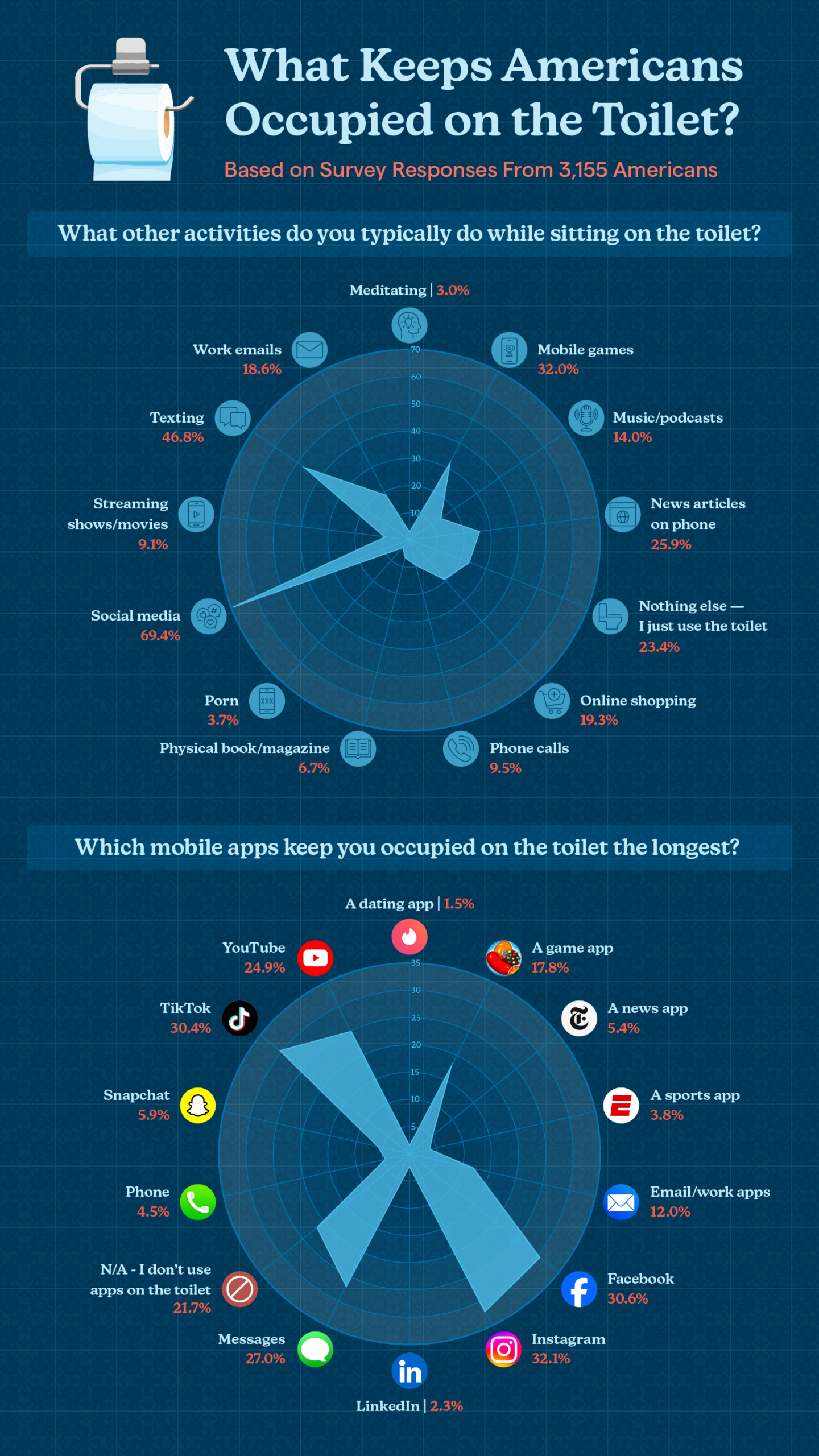
For many Americans, a bathroom break doubles as a chance to catch up on their phones. More than three in four respondents (76.6%) say they typically do something besides use the toilet while sitting there, most often scrolling social media (69.4%), texting (46.8%), or playing mobile games (32.0%).
When asked which mobile apps keep them occupied the longest, social media once again came out on top. Instagram leads at 32%, followed closely by Facebook (31%) and TikTok (30%). Messaging (texting), YouTube, and game apps also keep Americans on the toilet longer than intended. Thankfully, the toilet is not becoming a major hub for romance or career networking. Just 1.5% say dating apps occupy them the longest while on the toilet, while only 2.3% point to LinkedIn or job-hunting apps.
The Toilet Is a Scroll Break, Workstation, and Escape
America’s Favorite Place to Scroll
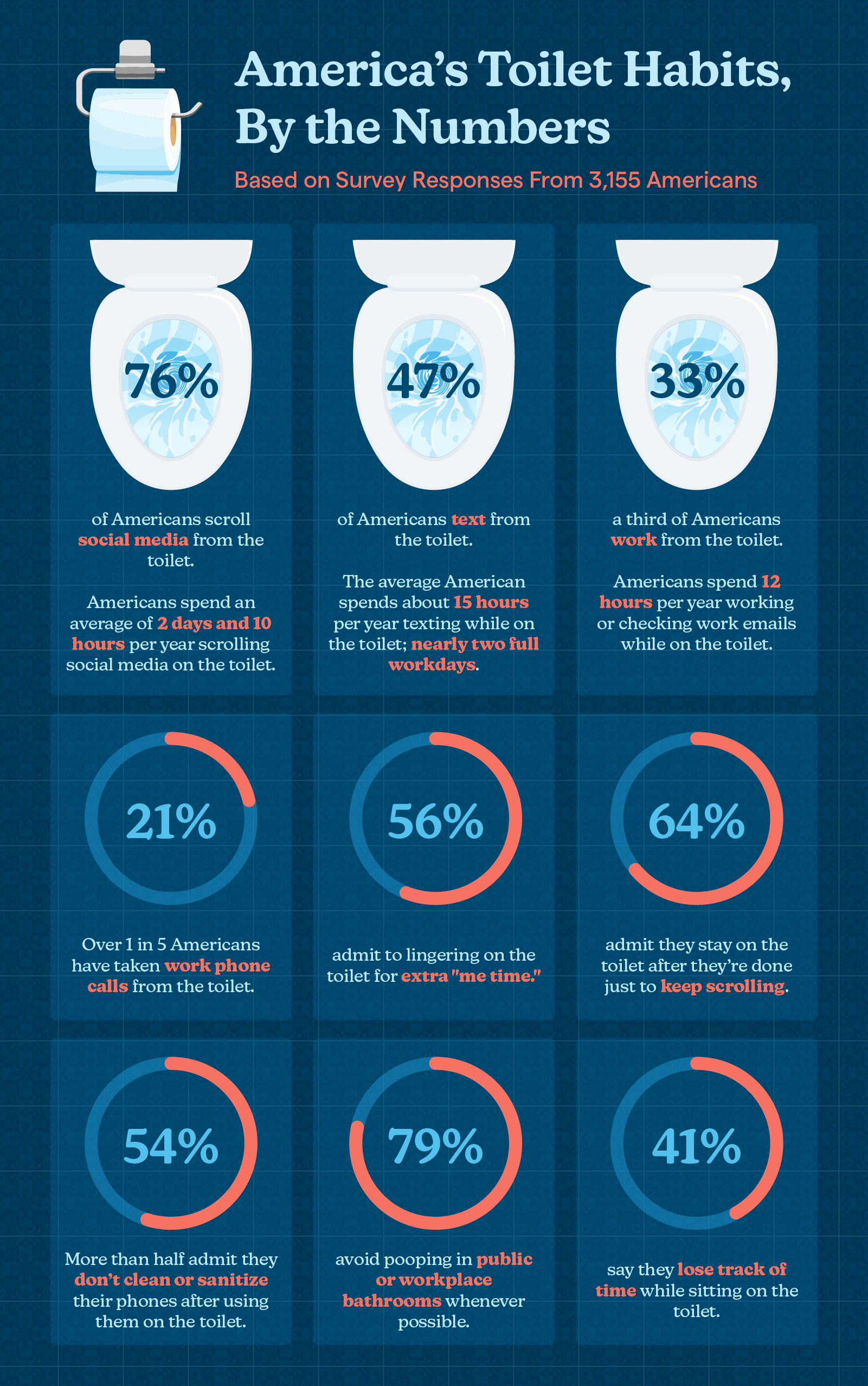
The phone comes into the bathroom with most Americans. Three in four (76%) scroll social media from the toilet, spending an average of two days and 10 hours each year doing it. That works out to nearly five hours a month, or almost 10 minutes every day. Gen Zers scroll social media from the toilet more than any other generation. They average 7 minutes scrolling social media per poop session. And for many people, the scrolling continues after the bathroom break is technically over. Nearly two-thirds (64%) admit they stay on the toilet after they are done just to keep scrolling.
Texting is not far behind. Nearly half of Americans (47%) text from the toilet, adding up to about 15 hours a year, or nearly two full workdays. Despite all that phone time from the toilet, 54% say they do not clean or sanitize their phone afterward.
A Few Extra Minutes of “Me Time”
The bathroom has also become a tiny escape from the rest of the day. More than half of Americans (56%) admit to lingering on the toilet for extra “me time,” and nearly 41% say they lose track of time while sitting there.
Gen Z is especially likely to turn a bathroom break into a breather: 66% say they linger for extra “me time,” more than any other generation. Men are also more likely than women to use the toilet as a chance to get a few uninterrupted minutes alone.
When Work Follows You to the Toilet
Even work is following Americans into the bathroom. One in three people (33%) say they work or check work emails from the toilet, while 21% have taken a work phone call there. Millennials are the generation most likely to have taken a work call from the bathroom.
Still, most Americans would prefer not to poop in a public or workplace restroom at all. Nearly 80% say they avoid doing so whenever possible. Gen Z is more comfortable than older generations, with 29% saying they do not avoid public or workplace pooping, more than 10 percentage points higher than Baby Boomers, Gen Xers, and Millennials.
The state of workplace toilet paper may not be helping. Just 13% of Americans rate it as high quality, while nearly 30% call it average and 28% say it is low quality.
What Americans Know About Bowel Health
Long bathroom visits are common, but not everyone realizes they may come with downsides. Nearly 38% of respondents said they were unaware that spending extended periods sitting on the toilet may contribute to anal discomfort or hemorrhoids. Gay respondents were the most likely to recognize the potential risks, with 73% reporting awareness compared with 53% of straight respondents.
According to Dr. Goldstein: “Spending too much time on the toilet and straining can contribute to hemorrhoids, but these are habits people can often overlook when thinking about their anal health. Simple changes, like leaving your phone outside the bathroom and getting enough fiber and fluids, can help support healthier bowel habits. If you’re regularly experiencing pain, bleeding, or difficulty passing stool, don’t let it slide – bring it up with your doctor so they can help you find relief.”
Even with all that toilet time, most Americans are not completely happy with their bowel movements. Nearly half (46%) say they are only somewhat satisfied, while just 21% are very satisfied. When Americans want to improve their bowel movements, they are most likely to start with everyday habits:
- 64% increase how much water they drink
- 46% change their diet
- 45% take a fiber supplement
- 33% exercise more
- 32% take a probiotic
- 31% use an over-the-counter stool softener or laxative
- 18% speak with a doctor or healthcare provider
Only 18% say they have not done anything specifically to improve their bowel movements.
When a Bathroom Habit Calls for More Attention
There is no prize for the fastest bathroom break, and an occasional long toilet session is not automatically a reason to worry. But the survey findings are a reminder to pay attention to what is keeping you there. If you are regularly dealing with pain, itching, swelling, straining, or bowel movements that do not feel right, it may be time to look beyond your phone and talk with a specialist.
Bespoke Surgical evaluates and treats anal-health concerns that can affect comfort in the bathroom, including hemorrhoids and anal fissures. Care can range from non-surgical options and at-home monitoring to in-office treatment or surgery, depending on a person’s symptoms and needs.
Your bathroom routine does not need to be perfect. The goal is to notice changes, avoid ignoring recurring discomfort, and get answers when something feels off. To learn more about Bespoke’s approach to anal health and sexual wellness, explore our services.
Methodology
Bespoke Surgical surveyed 3,155 Americans from September 4–16, 2026. The sample included representation across genders, generations, and sexual orientations. Alaska, North Dakota, Vermont, and Wyoming were excluded from the state-level analysis due to limited respondent counts in those states.
Fair Use
You are welcome to use, reference, and share non-commercial excerpts of this study with proper attribution. If you cite or cover our findings, please link back to this page so readers can view the full methodology, charts, and context.
Featured products
Read More
General
Would You Let AI Replace Your Partner, Doctor, or Therapist? [A Survey]
Artificial intelligence has quickly become part of everyday life. Increasingly, it’s also becoming part of...
General
What’s Your Number? The Average Number of Sexual Partners by State in 2026
Five years ago, Bespoke Surgical asked Americans a question that almost everyone has been asked...
General
The Average Penis Size in Every State
Penis size is one of those topics that manages to be everywhere and nowhere at...
